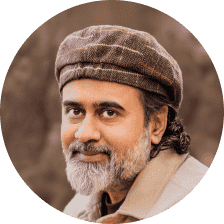
In a discussion with his former professor, Dr. Trilochan Shastry, Acharya Prashant addresses the perceived conflict between constitutional morality and cultural values in India. The conversation is framed around the idea that religion is often said to be in danger, with Dr. Shastry humorously noting that it is in danger from the very people trying to protect it. The moderator raises concerns about the rise of authoritarianism and discrimination in a society that is deeply religious, citing Dr. B.R. Ambedkar's view that democracy in India is a mere top-dressing on an essentially undemocratic soil. Acharya Prashant clarifies the distinction between Dharma (true religion) and belief systems. He states, "Dharma is never threatened. Only belief systems are threatened." He explains that the purpose of true religion is to free the individual from their suffering. The conflict between the constitution and culture arises because popular culture is based on 'Smriti'—texts like the Puranas and Dharma Shastras, which are based on human tradition and interpretation. In contrast, the Indian Constitution's core values of liberty, equality, and fraternity are deeply aligned with 'Shruti'—the eternal, revealed truths of Vedanta, the Upanishads, and the Bhagavad Gita. Acharya Prashant further explains that discrimination is a fundamental human tendency rooted in the unfulfilled ego, which seeks validation through external associations. This leads to blind discrimination based on conditioning, such as caste, gender, or wealth. He contrasts this with 'Viveka' (discretion), a key spiritual value taught in the Upanishads, which is the ability to differentiate the essential from the non-essential. He argues that the overemphasis on 'belief' (manyata) is the source of conflict, as beliefs are inherently insecure and clash with one another. True religion, he asserts, is freedom from false religion, which is nothing but belief. Concluding the discussion, Acharya Prashant reiterates that true religion is about self-realization (Atma-gyan) and liberation (Mukti) from ignorance (Avidya). It is anti-authoritarian and aims to bring individuals to the unity of the Self (Atman). Dr. Shastry agrees, adding that the essence of Hinduism, as found in the Upanishads, promotes equality and fraternity. He remarks that the cry of "religion in danger" is a political tool used by the power-hungry. The solution, both speakers imply, is to restore self-respect and dignity by returning to the essential, true religion of 'Shruti', which is in harmony with the constitution.